Services
- Brand Strategy
- Brand Messaging
- Campaign Development
- Branding
- Video
KPMG is a global professional services firm offering audit, tax, and advisory services, with more than 275,000 employees across 143 countries and $38.4 billion in annual revenue. For many organizations, KPMG is closely associated with audit – a reputation built carefully over decades. At the same time, the firm has steadily expanded its advisory practice, particularly within federal government sectors such as defense, supply chain, finance transformation, and government technology.
As those capabilities grew, market perception did not always reflect the full picture. Senior decision-makers often recognized the name, but not the breadth of advisory expertise behind it. This is a familiar challenge for established firms: how to help the market see what has evolved without unsettling the trust that already exists. Addressing that gap required a thoughtful approach to professional services branding – one grounded in clarity, credibility, and proof rather than reinvention.

The challenge was less about capability and more about communication. Advisory strengths, particularly in federal consulting, were not consistently visible in competitive, highly regulated markets. Meanwhile, peer firms were adopting more contemporary marketing approaches, subtly shifting expectations across the category.
Internally, progress was slowed by complexity. Brand and compliance standards were necessarily rigorous, approvals involved many stakeholders, and marketing teams were operating under tight timelines. Messaging refreshes were difficult to prioritize, and creative work often defaulted to what felt safest. Even practical details – such as sourcing accurate, compliant government and military visuals – proved challenging. Over time, these constraints limited campaign momentum and made it harder to clearly position KPMG as a comprehensive advisory partner.
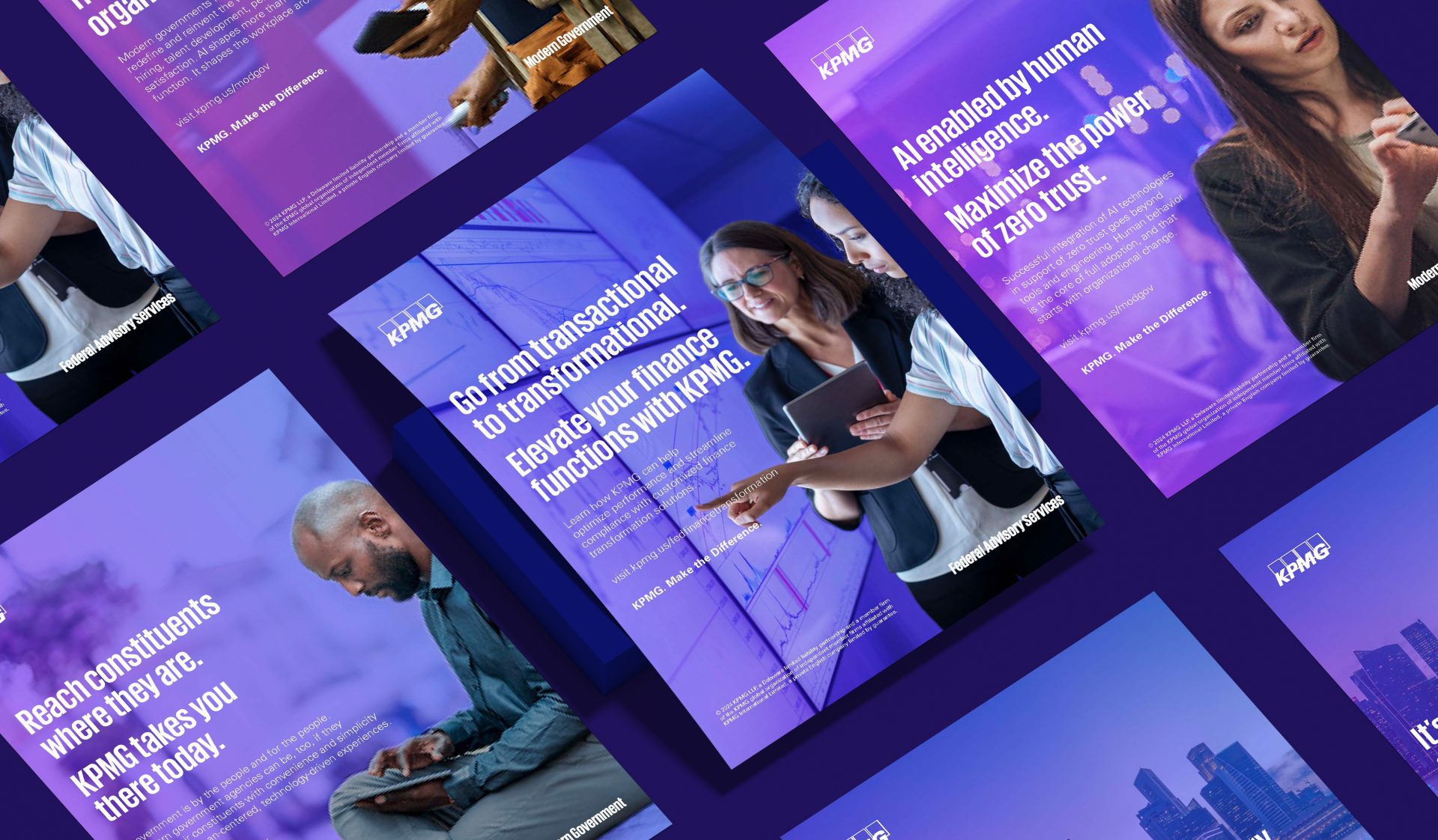
The work began with listening. Through stakeholder discovery across federal advisory teams, the focus was on understanding priorities, constraints, and where KPMG’s advisory work truly stood apart. From there, a brand messaging strategy took shape – one that emphasized evidence over assertion and outcomes over abstraction.
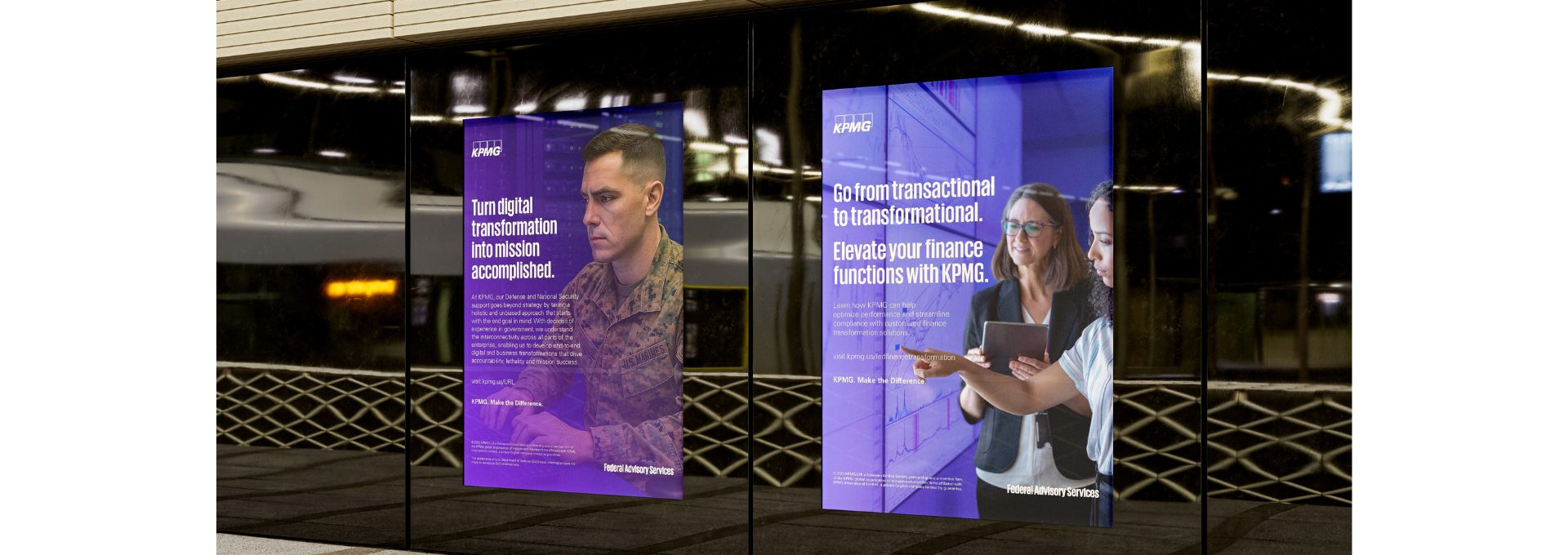
Rather than pursuing a dramatic rebranding strategy, the approach centered on articulating what was already true, but not always clearly expressed. Sector-specific messaging frameworks were developed for defense, supply chain, finance transformation, and government technology, supported by integrated print, digital, and video campaigns. Creative execution stayed within brand guidelines, while finding room to feel more modern through thoughtful layout, photography, and narrative flow.
To manage complexity, the process itself was refined. Early moodboards, clearer milestones, and more structured reviews helped align stakeholders sooner and reduce rework. This made it easier to move forward with confidence – carefully, but without unnecessary delay.
The result was a clearer, more confident expression of KPMG’s advisory capabilities within federal markets. Engagement increased across key government audiences, and inbound inquiries became more relevant and better aligned to priority service areas. Internally, the work was often described as “fresh but unmistakably KPMG,” reinforcing that creativity and credibility do not have to be at odds.
Over time, our improved workflows shortened approval cycles and built greater trust between teams, opening the door to more flexibility and creative exploration. The engagement expanded across additional business units and strengthened KPMG’s positioning in competitive transformation work – supporting both immediate growth and long-term brand health.